

Last updated: 11 August 2026 by the technicians at Max Appliance Repair Kitchener.
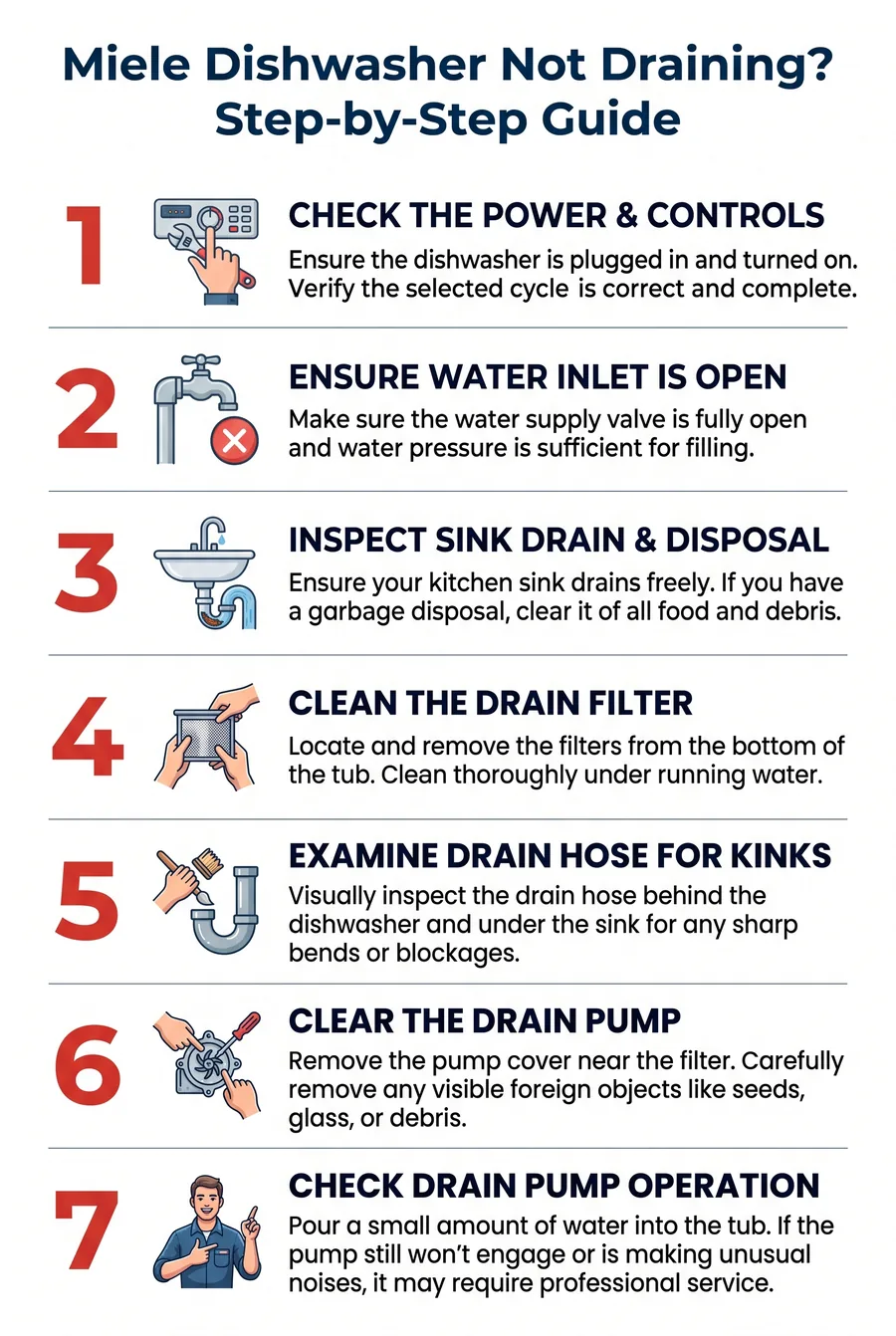
Standing water at the bottom of a Miele dishwasher after a cycle is one of the most common service complaints — and one of the most solvable. Miele dishwashers are built to exceptionally tight tolerances, which means they are more sensitive to blockages and less forgiving of skipped maintenance than budget models. This guide covers the 7 most common reasons a Miele dishwasher is not draining, starting with the steps you can do yourself in under 20 minutes.
Step 1: Check and clean the filter assembly
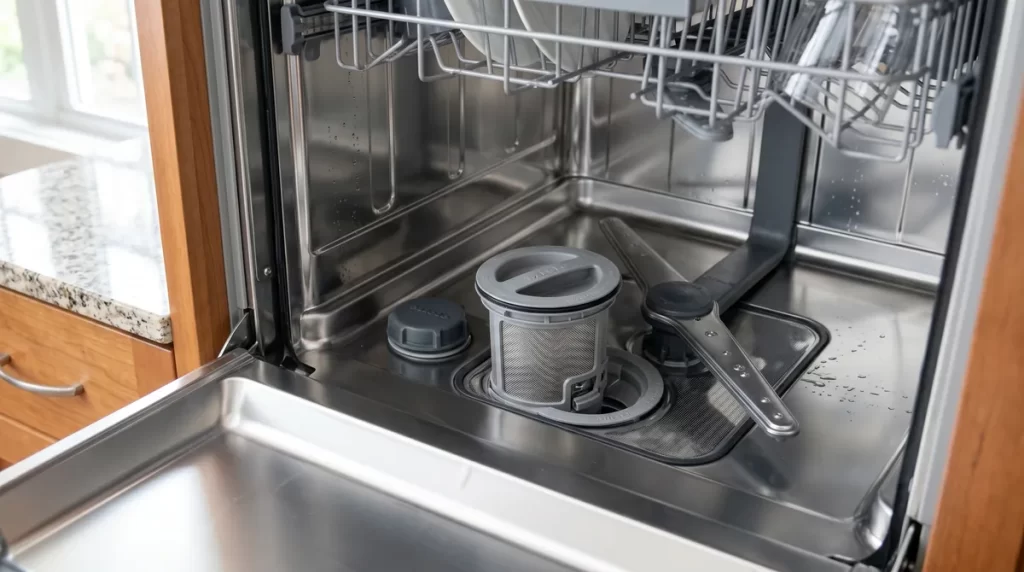
This is the first check on every Miele dishwasher that is not draining — and it resolves the problem in a significant share of cases. Miele dishwashers use a multi-part filter system at the bottom of the tub: a coarse filter screen, a fine mesh filter, and a micro-filter. All three catch food particles that would otherwise enter the pump. When they are clogged, water cannot pass through to the drain pump efficiently.
How to clean the filter:
- Remove the lower basket from the dishwasher.
- Turn the cylindrical filter handle counter-clockwise (Miele uses a twist-lock) and lift the filter assembly out.
- Separate the coarse and fine filter components.
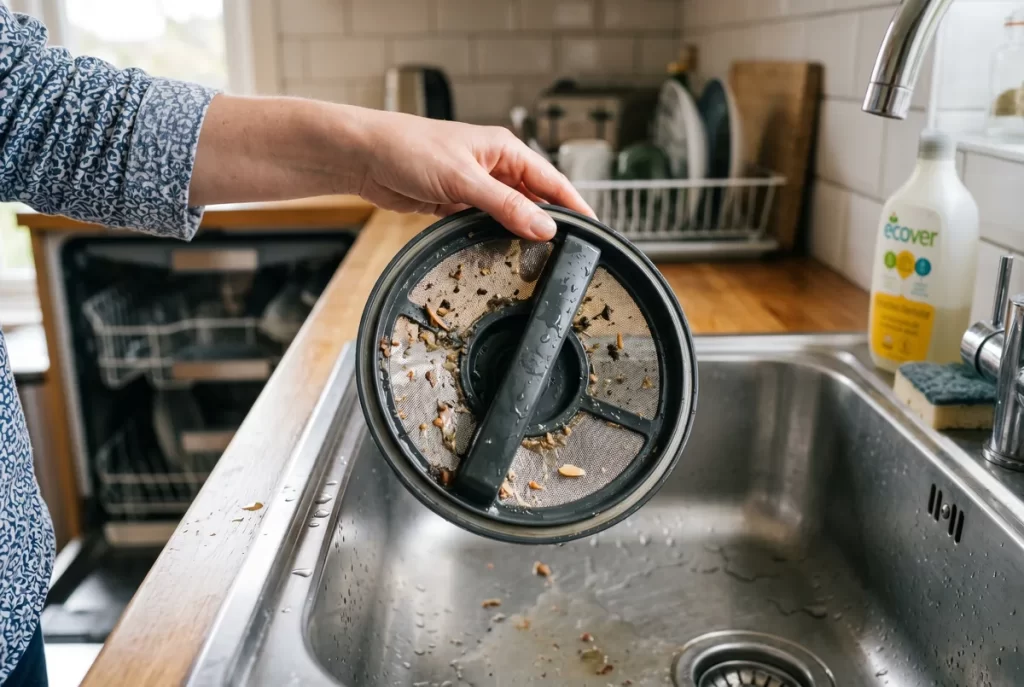
- Rinse all parts under running water, using a soft brush to clear any food debris from the mesh. Avoid abrasive scrubbers that can damage the fine mesh.
- Inspect the flat filter in the tub base (the one that stays in place) and remove any debris by hand.
- Reassemble and run a short cycle to test.
Miele recommends cleaning the filter assembly every 4 to 6 weeks under regular use. In Kitchener homes that run the dishwasher daily, monthly cleaning is a reasonable minimum.
Step 2: Check for a kinked or blocked drain hose
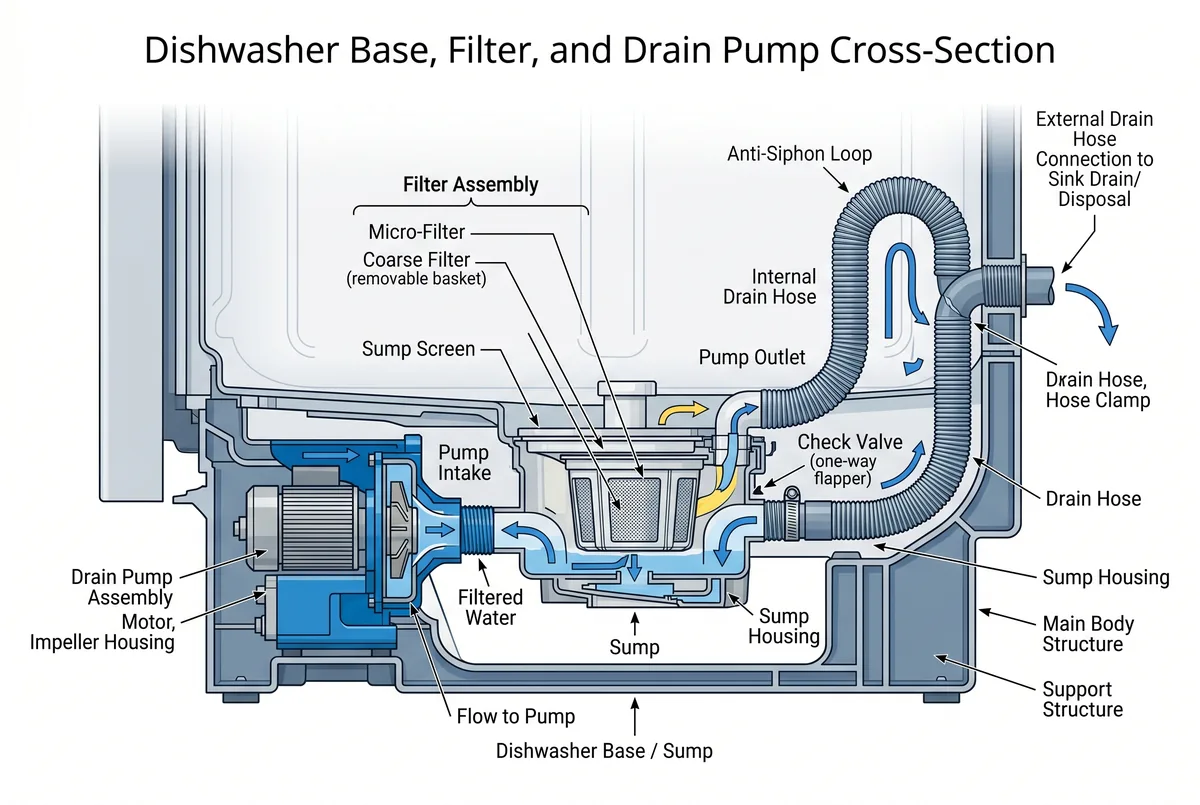
The drain hose carries water from the pump to the household drain (usually under the kitchen sink or connected to the garbage disposal). A hose that has kinked, been pinched by the dishwasher being pushed back against a cabinet wall, or has a partial blockage from accumulated debris will prevent complete draining.
Check: Pull the dishwasher out from under the counter slightly (or open the under-sink cabinet) to inspect the drain hose run. Look for sharp bends, kinks where the hose passes through cabinetry, or visible crushing from the dishwasher sitting on the hose. Straighten any kinks. Also check the high loop or air gap — the drain hose should form a high loop under the counter or connect through an air gap to prevent back-siphoning from the sink drain.
Step 3: Check the garbage disposal knockout plug
If the dishwasher drain connects to a garbage disposal, a common cause of drainage failure after a new disposal installation is the knockout plug — a plastic plug inside the disposal’s dishwasher inlet that must be removed during installation. If it was never removed, the dishwasher has nowhere to drain.
Check whether the disposal was recently installed or replaced. If so, disconnect the drain hose from the disposal inlet and look inside — if a plastic disc is blocking the opening, push it out with a screwdriver and remove it. Reconnect the hose and test.
Step 4: Inspect the check valve
The check valve (also called a non-return valve or ball valve) is a small one-way valve in the drain line that prevents drained water from flowing back into the tub between cycles. When this valve fails in the closed position, water cannot exit. When it fails stuck open, water siphons back in.
On Miele dishwashers, the check valve is typically located at the outlet of the drain pump or at the start of the drain hose. Access requires removing the dishwasher’s lower access panel. Check the valve for cracks, debris preventing it from opening, or a stuck flap. Replacement check valves are a Miele-specific part and typically run $15 to $30.
Step 5: Check for drain pump obstruction or failure
The drain pump is the component that actively moves water out of the tub. It can fail to drain for two reasons: a physical obstruction blocking the pump impeller, or motor failure.
Obstruction: Broken glass, small bones, fruit pits, and similar debris can pass the filter and jam the impeller. To check, access the pump from below the dishwasher (remove the lower access panel and tilt the dishwasher or access from inside after removing the filter). Feel the impeller area for foreign objects. This is a messy job but often clears the problem without any part replacement.
Motor failure: A failed drain pump motor produces no sound when the drain cycle should activate, or makes a humming sound without actually moving water. Listen carefully during the drain portion of the cycle. A professional diagnosis is the reliable way to confirm motor failure since the pump is not accessible during normal operation on most Miele models. Pump replacement on Miele dishwashers typically runs $150 to $300 for the part, with labour additional.
Step 6: Check for error codes
Miele dishwashers display fault codes in the form F followed by a number (F11, F13, F14, etc.) when the control unit detects a system fault. F11 specifically relates to drain water not being pumped out — it typically indicates a blocked drain, kinked hose, or drain pump fault.
When an F code appears, note the exact code before attempting any repair. Use your model number on Miele Canada’s support page to look up the specific meaning for your model. Error codes narrow the diagnostic field significantly and prevent unnecessary part replacements.
Step 7: Check the flood protection system
Miele dishwashers include a sophisticated flood protection system. A float switch in the base pan detects water accumulation caused by a leak or overflow. When triggered, the dishwasher activates the drain pump to empty the base and may disable normal operation. If the base has accumulated water from a slow leak, the machine will attempt to drain continuously and may not operate normally until the base is cleared and the underlying leak source is found and repaired.
Symptoms of an activated flood protection system include continuous draining sounds when the machine is idle, an F12 or similar flood protection code, or the machine refusing to start a normal wash cycle. This requires professional diagnosis to locate the source of the base water accumulation.
Important note
Disclaimer: This article is for general guidance only. Costs, products, regulations, and best practices change. Max Appliance Repair Kitchener is not liable for outcomes from actions taken based on this content. Always confirm with a licensed appliance technician for your specific situation. Some Miele repair work may affect warranty coverage — check your warranty documentation before proceeding with DIY repairs.
Frequently asked questions
Miele dishwasher repair in Kitchener
If the drain troubleshooting above did not resolve the problem, Max Appliance Repair provides Miele dishwasher repair in Kitchener with same-day and next-day appointments. Our technicians are experienced with Miele models and carry common Miele-compatible parts on every service vehicle.
Download: Miele Dishwasher Drain Troubleshooting Guide (PDF)
The complete 7-step guide with filter cleaning instructions in one printable page.
Sources and references
- Miele Canada — Miele Canada Official Support and Product Information
- RepairClinic — Dishwasher Not Draining Repair Help
- Consumer Reports — Dishwasher Reliability Ratings and Brand Reviews
Need a technician in Waterloo Region?
Still standing in water after working through this? Book dishwasher repair Kitchener or read our Miele appliance repair page. We also cover appliance repair Waterloo. Call (519) 783-0985, 7am to 10pm, seven days a week.