
Last updated: 11 August 2026 by the technicians at Max Appliance Repair Kitchener.
It is a quiet Kitchener morning, you press the button on your Jura, and instead of that smooth shot of espresso you get a blinking light, a weak trickle, or nothing at all. Few things derail a morning faster. The good news: when a Jura coffee machine is not working, the cause is usually something simple like a clogged screen, a dry brew unit, or a sensor that lost track of the water tank, and many of these you can sort out at your kitchen counter. The ones you cannot, our team handles through our coffee machine repair service.
Jura builds premium superautomatic machines, and that complexity is exactly why a small blockage can stop the whole brew. This guide walks through the most common Jura problems in the order a technician checks them, what to try yourself, and the warning signs that mean it is time to stop and call a pro.
In this article
- First, read what your Jura is telling you
- Problem: it powers on but makes no coffee
- Problem: weak, watery, or lukewarm coffee
- Problem: water, fill, or tank errors
- Problem: loud grinder or no grinding
- When to stop and call a technician
- What a Jura repair typically costs in 2026
- Frequently asked questions
First, read what your Jura is telling you
Safety first: The tips here are for general guidance only. Max Appliance Repair Kitchener is not responsible for any damage, injury, or cost resulting from action taken based on this content. Before you touch any appliance, unplug it or switch off its breaker. If a step calls for opening a sealed refrigerant system, working on a gas connection, or anything you are not fully comfortable with, stop and call a licensed technician.
Before you touch anything, note exactly what the machine does. Does the screen show a maintenance prompt or an error code? Does the pump run but no coffee comes out? Is the coffee weak, or is it cold? Each symptom points to a different part, and Jura machines are good at telling you what they need if you slow down and read the display. Write down the model (it is usually on a sticker underneath or behind the bean hopper) so you know which guidance applies.
Two habits prevent most Jura faults: running the descaling and cleaning cycles when the machine asks, and using filtered water. Hard water across Waterloo Region leaves scale that clogs the narrow internal lines, and skipped cleaning cycles let coffee oils gum up the brew unit. Keep those up and you avoid a surprising share of breakdowns.
Problem: it powers on but makes no coffee
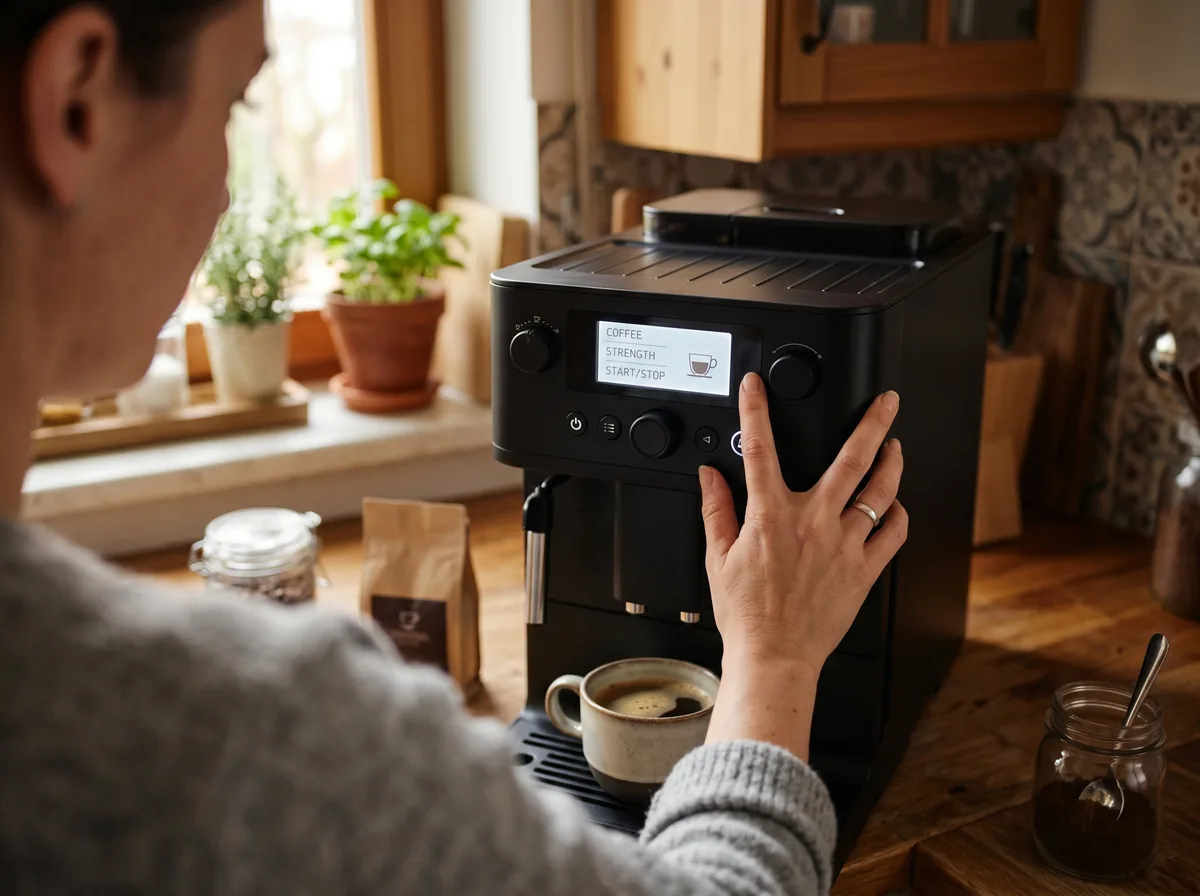
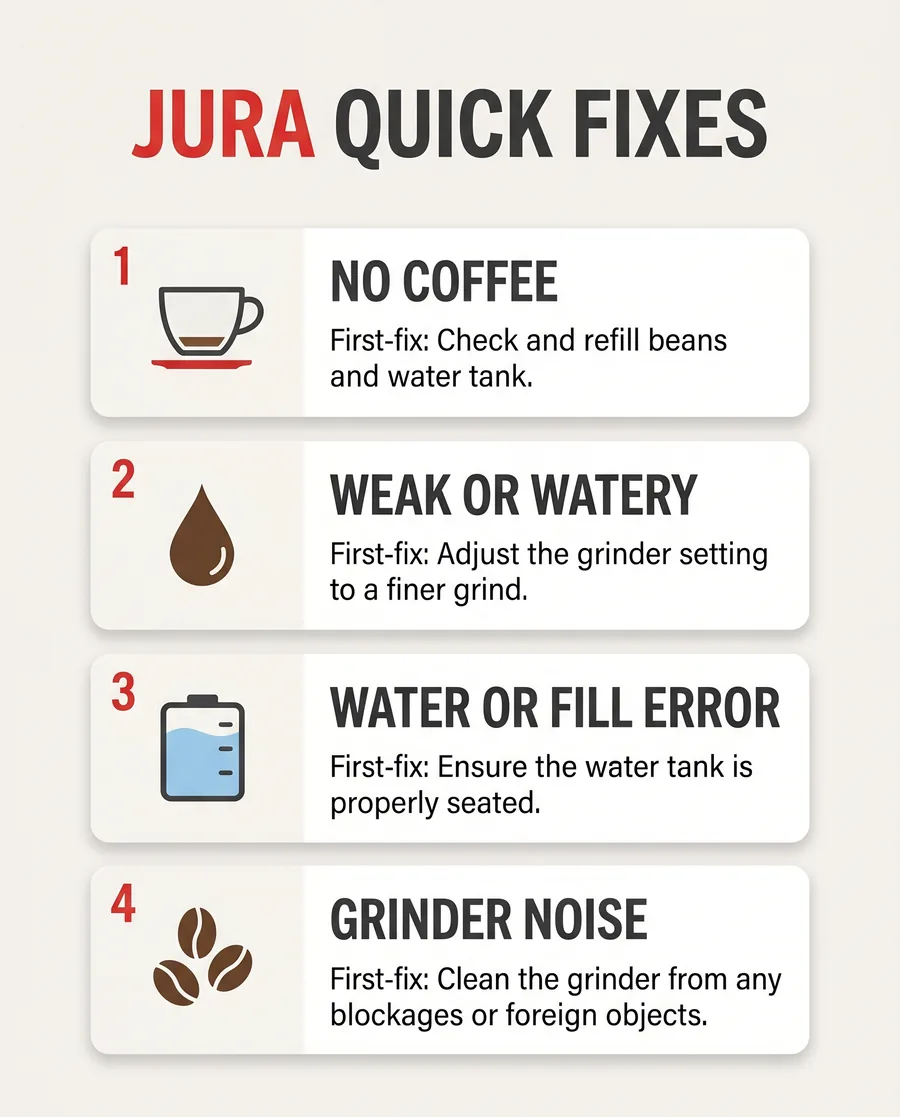
This is the classic Jura complaint. The machine lights up, the pump hums, but coffee runs straight into the drip tray or nothing reaches the cup. Nine times out of ten it is a blockage somewhere in the path from the water tank to the spout. Work through these in order:
- Check the water tank seats fully. Pull it out, rinse it, and push it back until it clicks. A tank that is slightly proud of its seat can break the connection and stop the brew.
- Run a clean-and-rinse cycle. If the machine is prompting for cleaning, give it the cleaning tablet it wants. Old coffee oils can choke the brew unit until it is cleaned.
- Clear the micro screen. Many Jura models have a fine mesh screen behind the spout area that catches grounds. When it clogs, you get a fill or no-flow error. The video below shows this exact fix.
- Descale if it is overdue. Scale narrows the internal tubing. A full descale with Jura solution often restores flow on its own.
Pro tip: the brew unit loves a weekly rinse
On models with a removable brew unit, take it out, rinse it under warm water (no soap), let it dry, and pop it back. It takes two minutes and clears the gummy coffee residue that causes most no-coffee faults. On sealed models that you cannot open, run the built-in cleaning cycle instead and never force the unit.
Problem: weak, watery, or lukewarm coffee
If the coffee flows but tastes thin or comes out cool, the machine is working but something is off in the grind, the dose, or the heating. Start with the easy wins:
- Adjust the grind finer. A grind set too coarse lets water rush through without extracting. Only change the grinder setting while the machine is grinding, as Jura instructs, or you can damage the burrs.
- Bump up the coffee strength and volume. A short, strong setting with a small water volume gives a richer cup than a long, weak one.
- Use fresh beans. Stale or oily beans clog the chute and brew poorly. Buy smaller bags and keep them sealed.
- Let it warm up. Lukewarm coffee can simply mean a cold cup or a machine that did not finish heating. Pre-rinse to warm the system, and warm the cup first.
Did you know? Scale is the silent Jura killer
Limescale from hard water is the leading cause of weak flow and heating faults in superautomatic machines. Most of Waterloo Region runs on moderately hard water, so a Jura here needs descaling more often than the manual suggests for a soft-water area. If your machine never prompts to descale because you cleared the reminder, set a calendar nudge every two to three months instead.
People often ask: is it worth repairing a Jura or should I replace it?
For a genuine Jura, repair is almost always the smart move. These are premium machines that often cost well over a thousand dollars new, so a professional repair that brings one back to life is a fraction of replacement. The exception is an older machine with a failed main board or pump that costs nearly as much as a newer model. A technician can tell you which camp yours falls into before you spend a cent on parts.
Problem: water, fill, or tank errors
Jura machines watch their water supply closely, so “fill the tank” or fill-system errors are common even when the tank looks full. The usual culprits are an air-locked line, a dirty tank sensor, or that clogged micro screen again.
- Refill and reseat the tank. Empty it, rinse it, fill to the line, and seat it firmly. Wipe the contacts where the tank meets the machine.
- Burp the line. If the pump runs dry after you refilled, the line may have an air pocket. Run a hot-water or rinse function a couple of times to draw water through.
- Clean the micro screen. A blocked screen reads as a fill error on many models. Remove and rinse it as shown in the video above.
Problem: loud grinder or no grinding
A Jura grinder should make a brief, even whir. A loud rattle, a grind that never produces coffee, or a screech points to a foreign object, an empty or bridged hopper, or worn burrs.
- Empty the hopper and look for stones or debris. A small stone in the beans can jam or wreck the burrs. Roasters occasionally miss one.
- Check for bean bridging. Oily beans can stick together and bridge over the grinder so nothing feeds. Tap the hopper and stir the beans.
- Listen for metal on metal. A grinding or screeching sound can mean worn burrs, which is a technician job, not a kitchen fix.
Red flag: stop here and call a pro
- A burning smell, smoke, or a tripped breaker when you run the machine.
- Water leaking from inside the body rather than the tank or tray.
- A grinding or metallic noise that does not clear when you empty and check the hopper.
- An error code that returns after cleaning, descaling, and reseating the tank.
When to stop and call a technician
Jura superautomatics are sealed, pressurized, and electrically complex. Cleaning, descaling, reseating the tank, and rinsing the brew unit are fair game at home. Opening the casing, working on the pump, thermoblock, or main board, or chasing an internal leak is not. Those repairs need the right parts, the diagnostic tools, and an eye for the pressurized water and live electrical components inside.
We service high-end coffee machines across Kitchener, Waterloo, Cambridge, and Guelph. If your machine is a Jura, Breville, De’Longhi, Saeco, or another premium brand, we can diagnose it and get it brewing again. See the full list of brands we repair, or read our take on what separates the best kitchen appliance brands for Canadian homes.
What a Jura repair typically costs in 2026
Pricing note: The figures on this page reflect typical market rates in Kitchener, Waterloo, Cambridge, and Guelph as of 2026. What you actually pay depends on the make, model, and age of the appliance, the parts involved, and how easy it is to reach the fault. Always ask for a written quote or an in-person diagnostic before approving a repair.
High-end coffee machine repairs at Max Appliance Repair Kitchener start at $199, which covers the diagnostic and common service work. The ranges below help you sanity-check a quote, not lock in a price.
| Type of Jura issue | Typical 2026 range | Usually involves |
|---|---|---|
| Clean, descale, micro-screen service | From $199 | Cleaning cycle, descale, screen and brew-unit service |
| Brew unit service or replacement | $199 to $350 | Removing, cleaning, or swapping the brew group |
| Pump or flow-meter repair | $250 to $450 | Diagnosing and replacing the pump or sensor |
| Heating (thermoblock) repair | $300 to $500 | Testing and replacing the heating element |
| Control board diagnosis | Quote after diagnostic | Board test; replacement only if cost-effective |
Not sure whether your machine is worth fixing? So is replacing a dishwasher, and we wrote a full guide on how to tell when to repair or replace an appliance that applies to coffee machines too. For the bigger picture, see our breakdown of appliance repair costs across Kitchener-Waterloo.
Sources and further reading
- Max Appliance Repair Kitchener, in-house service data and 2026 Kitchener-Waterloo pricing observations.
- Region of Waterloo, water hardness information for the Kitchener-Waterloo-Cambridge area.
- The Jura Guy, “Jura Fill System Error, Micro Screen Cleaning” (video, embedded above).
Frequently asked questions
Why is my Jura making coffee but it is weak and watery?
Weak or watery coffee from a Jura almost always traces back to the grind, the dose, or the beans rather than a broken machine. A grind set too coarse lets water rush through without pulling flavour, so try a finer setting (only adjust while the grinder is running). Raise the coffee strength and reduce the water volume for a richer cup, and switch to fresh, properly stored beans. If the coffee is also cool, pre-rinse to warm the system and warm the cup. If none of that helps, the brew unit or heating element may need service.
How often should I descale a Jura in Kitchener-Waterloo?
Plan to descale every two to three months in this area. Most of Waterloo Region has moderately hard water, which leaves scale faster than the soft-water schedule many manuals assume. Scale narrows the internal tubing and is the leading cause of weak flow and heating faults in superautomatic machines. Always use the Jura descaling product and run the full cycle the machine asks for. Filtered water and regular cleaning cycles between descales keep the inside clear and prevent most breakdowns before they start.
Is it safe to take apart my Jura coffee machine myself?
You can safely remove and rinse the water tank, drip tray, and (on applicable models) the brew unit and micro screen, and you can run the built-in cleaning and descaling cycles. You should not open the outer casing or work on the pump, heating block, or circuit board yourself. Those areas combine pressurized water with live electrical parts, and a wrong move can cause injury or turn a small fault into an expensive one. If the problem survives cleaning, descaling, and reseating the tank, have a technician open it.
Is repairing a Jura worth it, or should I just buy a new one?
For a real Jura, repair is usually the smart choice. These are premium machines that cost well over a thousand dollars new, so a professional repair is a fraction of replacement and gets you years more service. The main exception is an older machine that needs a major part like a main board plus a pump, where the total approaches the price of a newer model. A diagnostic visit tells you which situation you are in, so you are never guessing about whether to invest in the machine you have.
Why does my Jura say to fill the water tank when it is already full?
A full tank that still triggers a fill error usually means the machine cannot draw water, not that the tank is empty. The common causes are a tank that is not seated firmly, dirty contacts where the tank meets the machine, an air pocket in the line, or a clogged micro screen that the machine reads as no flow. Reseat and rinse the tank, wipe the contacts, run a rinse cycle a couple of times to clear any air, and clean the micro screen. If the error returns after all of that, book a service visit.
The verdict
When a Jura quits, resist the urge to assume the worst. Read the display, clean and descale, reseat the tank, rinse the brew unit, and check the grinder. Those five moves fix the large majority of Jura complaints in a Kitchener kitchen. If the fault survives all of that, or you see any of the red-flag signs above, it is a technician job, and a good repair is well worth it on a machine this well built.
Download the free quick guide
Keep our printable five-step Jura checklist on the fridge so the next coffee emergency is a two-minute fix, not a ruined morning.
Jura still not brewing in Kitchener or Waterloo?
Our technicians service high-end coffee machines across Kitchener, Waterloo, Cambridge, and Guelph, with repairs starting at $199. Book a coffee machine repair, check whether we cover your Waterloo neighbourhood, or contact our team for a same-day appointment. We will get you back to a proper espresso.
Need a technician in Waterloo Region?
Built-in coffee machines are fiddly and most repair shops will not touch them. Book coffee machine repair Kitchener. We also cover appliance repair Waterloo and appliance repair Cambridge. Call (519) 783-0985, 7am to 10pm, seven days a week.