


Last updated: 11 August 2026 by the technicians at Max Appliance Repair Kitchener.
A refrigerator running constantly in summer is not always broken. When the kitchen hits 30 degrees and the door opens twenty times a day, your fridge simply has to work harder to stay cold, so longer run times are partly the season. The trouble is telling normal summer effort apart from a real fault like dirty coils, a failing door seal, or a struggling thermostat. Before you assume the worst and book refrigerator repair in Kitchener, run through the causes below. Several are fixable in an afternoon.
Here is what actually drives a fridge to run nonstop when the weather turns hot, how to spot which cause is yours, and the point where constant running stops being seasonal and starts costing you a compressor.
In this article
Why summer makes any fridge work harder
A refrigerator does not make cold. It moves heat out of the box and dumps it into your kitchen. The bigger the gap between the temperature inside the fridge and the air around it, the harder that job is. In a Kitchener July, with the kitchen warm and humid, the compressor runs longer just to hold the same 3 or 4 degrees Celsius it held easily in February.
So some extra running in summer is normal and expected. Run time varies by model, room temperature, food load and door use. Continuous operation combined with warm food, abnormal heat or unusual noise requires diagnosis. What is not normal is a fridge that never cycles off at all, or one that runs constantly and still cannot get cold. That combination points to a fault the heat is only exposing.
Quick take
Longer run times in summer are normal. A refrigerator running constantly in summer becomes a problem when it never shuts off, when it runs hard but the food is warm, or when the sides feel hot to the touch. Those signs mean a cause beyond the weather.
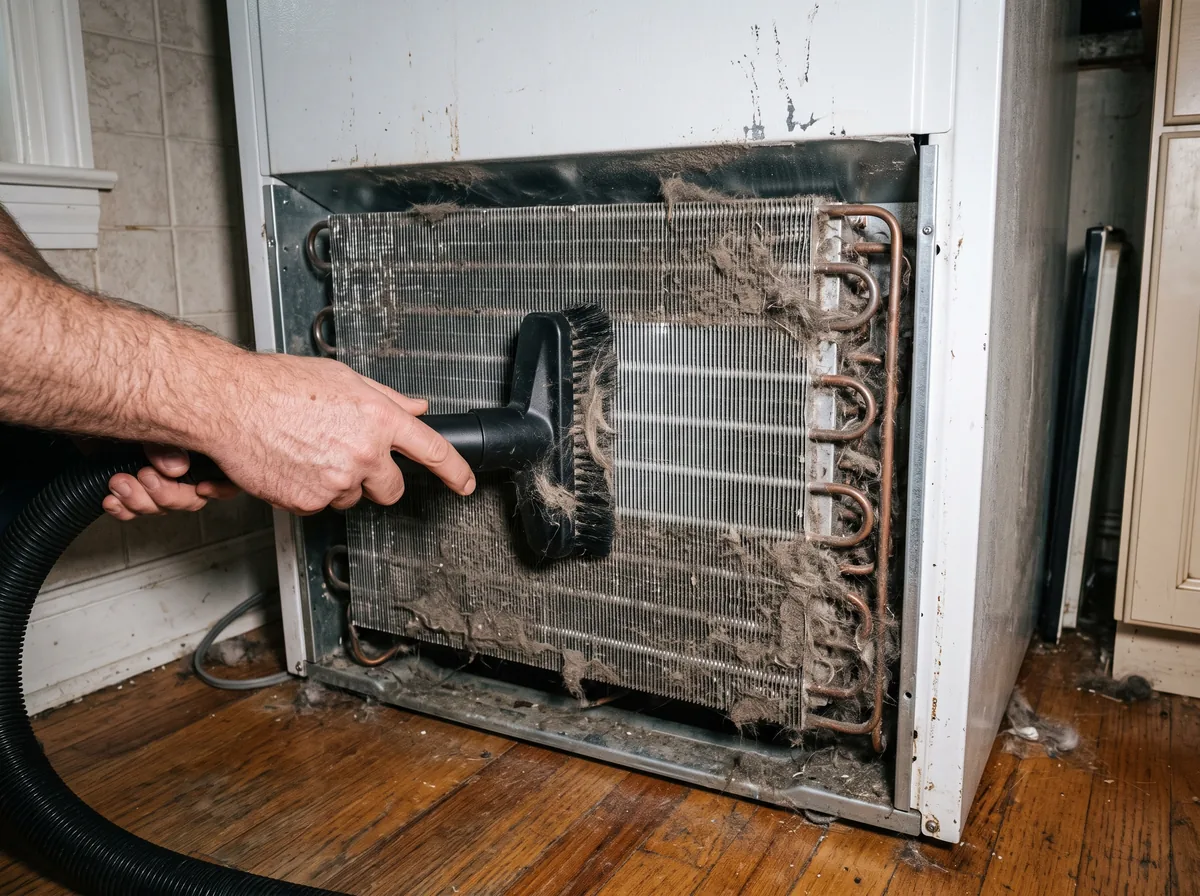
Dirty condenser coils: the top hidden cause
If we had to name the single most common reason a fridge overworks in summer, it is dirty condenser coils. Those coils, usually behind or underneath the fridge, are where the heat gets released. When they are coated in dust, pet hair, and kitchen grease, they cannot shed heat efficiently, so the compressor runs longer and longer to compensate. Summer heat then stacks on top of an already choked system.
The fix is often just cleaning. Unplug the fridge, find the coils, and vacuum them along with a coil brush. In homes with pets, coils can clog within a year. If the fridge has felt like it runs more every summer, dirty coils are the first thing to rule out, and it costs nothing but twenty minutes.
People often ask: how often should I clean my refrigerator coils?
Once or twice a year for most homes, and every three to four months if you have shedding pets or the fridge sits in a warm, dusty spot. Clean coils are one of the cheapest ways to cut run time and stretch the life of the compressor. A fridge forced to run hard on clogged coils through a hot summer is a fridge aging fast.
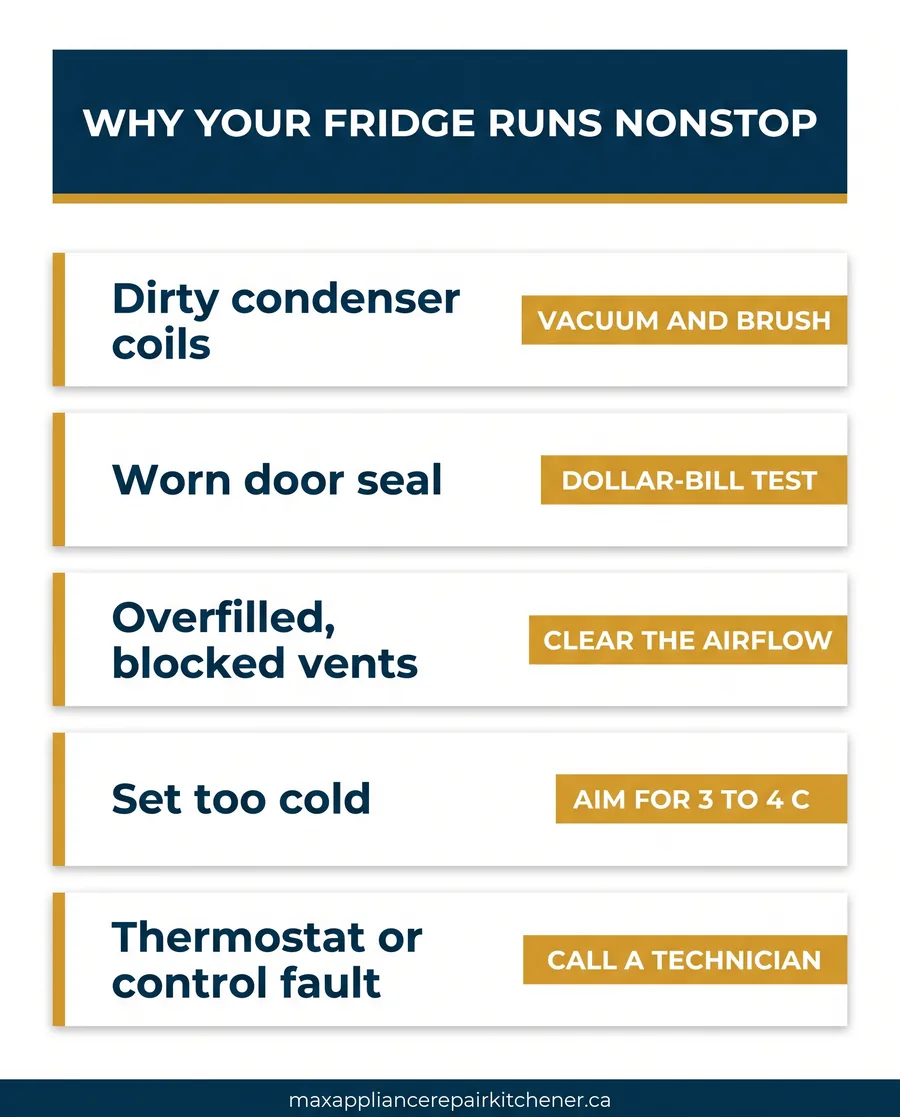
Door seals, overfilling, and airflow
After the coils, the next cluster of causes is about keeping cold air where it belongs and letting it move. Any one of these makes a fridge run longer, and summer heat magnifies all of them.
Worn door gaskets
The rubber gasket around the door is the seal between cold inside and warm kitchen. When it hardens or tears, warm humid air leaks in constantly and the compressor never catches up. Try the dollar-bill test: close the door on a bill and pull. If it slides out with no resistance, the seal is weak there. A leaking gasket in July is a fridge that runs nonstop by design.
Overfilling and blocked vents
A packed fridge feels efficient but often is not. Cold air has to circulate, and food shoved against the interior vents blocks that flow, so some areas stay warm and the fridge keeps running to compensate. Leave space around the vents, usually at the back or top of the compartment.
Where the fridge sits
A fridge crammed tight against a wall, next to the oven, or in a sun-filled corner has nowhere to dump its heat. Give it a few centimetres of breathing room on the sides and back, and keep it out of direct summer sun if you can.
Pro tip
Wipe the door gaskets every couple of months with warm soapy water and check for cracks. Grease and crumbs stop the rubber from sealing and speed up cracking. A clean, supple gasket is the cheapest way to keep summer air out and run times down.
Thermostat and control faults
Sometimes the fridge is clean and sealed and still runs nonstop, and the cause is electrical. A failing temperature control or thermostat can tell the compressor to keep running when it should cycle off. A common homeowner mistake also hides here: the temperature dial cranked colder than it needs to be. A fridge set to its coldest setting will run far longer than one set to a sensible 3 or 4 degrees Celsius, and in summer that difference is large.
Start with the setting. If the fridge is at 3 to 4 degrees Celsius and the freezer at minus 18, and it still runs constantly, the thermostat, control board, or a sensor may be at fault. Those are diagnostic jobs rather than clean-and-check fixes, and they are where a technician earns their call.
Normal run time versus a real problem
Use this as a rough guide to tell seasonal effort apart from a fault. Run time is how much of each hour the compressor is actually running:
| What you notice | Likely normal | Worth investigating |
|---|---|---|
| Run time on a hot day | Varies by model, room temp, food load and door use | Never cycles off at all |
| Fridge temperature | Holds 3 to 4 C | Runs hard but food is warm |
| Sides of the cabinet | Warm near the coils | Hot to the touch |
| Seasonal pattern | Longer in summer, eases in fall | Runs more every single summer |
| Noise | Steady hum | New clicking, buzzing, or silence |
What to do when your fridge runs nonstop
- Check the temperature settings first. Aim for 3 to 4 degrees Celsius in the fridge and minus 18 in the freezer.
- Unplug the fridge and vacuum the condenser coils behind or beneath it, using a coil brush to reach the dust.
- Test the door seals with the dollar-bill test at several points, and clean or replace a gasket that no longer grips.
- Pull food away from the interior vents so cold air can circulate, and avoid packing the fridge wall to wall.
- Give the fridge breathing room on the sides and back, and move it out of direct sun or away from the oven if you can.
- Plug it back in and watch it over a day. If it still never cycles off, note that for the technician.
When constant running means call a pro
Call for service when the fridge never cycles off even after clean coils and a good seal, when it runs hard but the food is warm, when the sides are hot to the touch, or when you hear new clicking, buzzing, or a sudden silence. Those are compressor, control, and refrigerant faults, not seasonal effort. Max Appliance Repair Kitchener diagnoses why a fridge runs nonstop and fixes the actual cause, so you are not paying to cool the neighbourhood through August.
Download the free quick guide
A one-page checklist to find why your refrigerator runs nonstop in summer and fix the causes you safely can.
Frequently Asked Questions
Fridge running nonstop and the bill climbing through the summer? Max Appliance Repair Kitchener diagnoses and repairs refrigerators across Kitchener, Guelph, and Waterloo. Book a refrigerator diagnosis and we will find the real cause, not just clean the coils and hope.
The temperatures that matter
- Health Canada gives 4C or colder for the fridge compartment and -18C (0F) for the freezer. If your fridge is sitting above 4C, that is a food safety problem, not just an inconvenience.
- A fridge that never cycles off is usually fighting dirty condenser coils, a worn door gasket, or a stuck defrost cycle, and it will show up on your hydro bill before it shows up as a breakdown.
- Measure it properly: stand a thermometer in a glass of water in the middle of the compartment and read it after 8 hours, rather than trusting the door display.
- Comparing running costs on a replacement? Natural Resources Canada publishes the ENERGY STAR certified list for Canada.